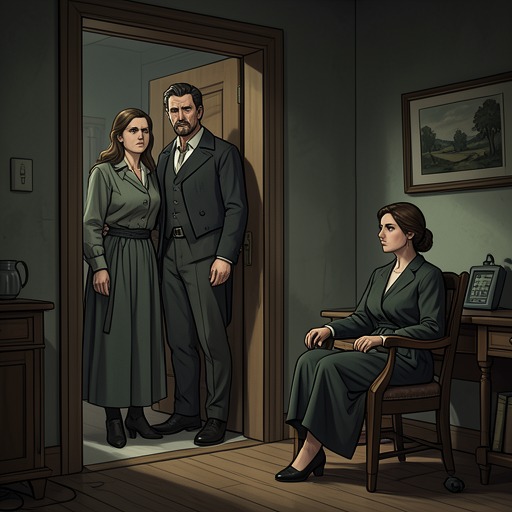
J.D. punches Chris to defend a classmate
Hillbilly ElegyJ.D. Vance punches Chris to defend a classmate after deciding that avoiding a bully’s attention is no longer acceptable. The episode turns Mamaw’s advice about fighting into a test of responsibility: Vance must act for someone else, then face the consequences of acting. The school’s muted response and Mamaw’s approval leave the incident poised between discipline and moral recognition, while Vance remembers it as the last fistfight of his childhood.
The Bullying and the Decision to Intervene
The episode begins the year after Mamaw had impressed on Vance that fighting should be avoided unless necessary. Vance was usually protected from the class bully by his earlier exploits, and, like most of the children around him, he was content to keep the bully’s attention elsewhere. The target was a classmate Vance rarely spoke to, an odd and particularly vulnerable boy. Seeing the bully single him out made the cost of Vance’s habitual avoidance harder to ignore.
Vance’s decision does not arrive as effortless courage. After hearing the bully say something about the boy, he feels a strong urge to defend him, but he does not speak up at once. That afternoon, he tells Mamaw what happened and breaks down in tears over his own silence. He says that he had already spoken to the teacher, but still feels guilty for having listened while the bully made the other child’s life miserable. The scene makes the conflict less about Vance’s capacity to fight than about the gap between recognizing harm and taking responsibility for stopping it.
Mamaw responds by widening the principle she had given him earlier. Fighting, in her account, can be justified not only in self-defense but also when defending another person is simply the right thing to do. She tells him to stand up for the boy the next day, and prepares him for the possibility that he may also have to defend himself. Her instruction is practical as well as moral: she teaches him to turn his hips when throwing a punch. Her advice gives Vance a specific action to take, but the choice to act remains his.
The School Confrontation
The following day, Vance feels nervous and hopes the bully will be absent. The confrontation comes amid the predictable disorder of the class lining up for lunch. Chris asks the targeted boy whether he plans to cry that day. Vance tells him to stop and leave the boy alone. Chris then approaches Vance, pushes him, and challenges him to do something about it. Vance steps toward him, pivots his right hip as Mamaw taught him, and punches him in the stomach.
The immediate result frightens Vance. Chris drops to his knees and struggles to recover; Vance realizes that the punch has seriously affected him. Chris goes to the school nurse. The event therefore changes sharply from a planned act of intervention into a situation whose consequences Vance cannot control. His thoughts turn to what the school might do: he wonders whether he will be suspended or expelled, and for how long. His concern is not only the classroom’s judgment of his motive but also the formal punishment that may follow the violence.
The School’s Response and Mamaw’s Judgment
While the other children are at recess and Chris is recovering with the nurse, the teacher brings Vance into the classroom. He expects to be told that his parents have been called and that he will be removed from school. Instead, the teacher lectures him about fighting and assigns handwriting practice in place of outdoor play. The punishment is real but limited: he misses recess, rather than being suspended or expelled. Vance detects a hint of approval in the teacher’s manner, though he can only speculate that school politics may have contributed to her earlier failure to discipline the bully effectively.
Mamaw learns about the fight directly from Vance, not through a report from the school. She praises him for doing something good. That response does not erase the teacher’s lecture or make the punch consequence-free; it gives the act a different moral interpretation. The institution addresses the rule he broke, while Mamaw recognizes the reason he broke it. The episode leaves those judgments side by side instead of claiming that one cancels the other.
Meaning and Ending
The decisive change in the episode is that Vance moves from private distress to intervention. His first conversation with Mamaw centers on guilt about remaining silent; the next day he accepts the risk of drawing the bully’s attention to himself. The result is not a general conversion to fighting. After Mamaw praises him, Vance identifies this as the last time he ever got into a fistfight. The ending therefore sets a boundary around the violence: the story presents one act as a response to a particular failure to protect someone, not as an enduring habit or a license to retaliate.
The scene also develops Mamaw’s influence through action rather than abstract instruction alone. Her earlier warning against unnecessary fights and her later direction to defend a classmate form a conditional ethic: restraint matters, but it does not excuse standing aside when another person is being mistreated. Vance’s nervousness, his practical use of the move she taught him, and his fear of school punishment keep that ethic grounded in a child’s uncertain decision. The episode’s significance lies in that uncertainty: doing what he believes is right does not remove the risk, the physical consequences, or the need to answer for what he has done.